Commonwealth (Review)
So, a bit of context. To really understand where Commonwealth is coming from, we're going to need to talk about another game first.
There's this game called En Garde!. It's been around for decades, since 1975. That makes it one of the first RPGs published after Original Dungeons and Dragons. And it's a fascinating little game. Unlike most games from that period it owes almost nothing to D&D at all. Rather than a combat game about killing monsters and taking their treasures in dungeons, it's a tactical simulation of social interaction. There's not a wizard or a hobbit to be seen. It's not fantasy, it's a fictionalised version of 17th century Paris; think Three Musketeers. While wealth is all very nice, the real focus of the game is on social climbing and parties and courting mistresses. (The game does show its age in its assumption that no player could want to play a woman). You're not the atomised adventurers of D&D, you're fully part of Parisian society. It doesn't need a GM and, as written, there is a closed list of actions you can choose to carry on. I could go on, but you get the point. It's arguably the first fully "not based on D&D game released.
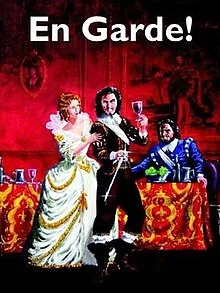
And it still has a small but enthusiastic following. There's several games going on as we speak, including mine. (Open places for players if you're interested). The community has always been a hotbed of creativity, with house rules (running from going to the theater to catching venereal disease) abounding. And it's been converted to a massive variety of settings. There have been games set in The Vatican, a Lovecraftian University, a Dune like world, Glorantha and many more.
But they've always been En Garde! It's a slightly odd situation, where the community is pretty insular. Specifically, it seems to have had almost no influence other than on itself. There are few RPGs that it obviously inspires. It's very much another path not taken when it comes to RPGs. And it's been that way for a long time.
Until the recent release of Commonwealth. Commonwealth is the first game I've come across that manages to be in the genre of En Garde while being very much its own thing rather than a collection of En Garde house rules.
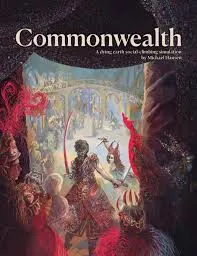
The world of Commonwealth is rather a colourful one. It's full of "Dragoman of the Sublime Gate" and "The Bacellae of Irregular Contarii" and "Dome of Delectation". This was definitely a good thing. It instantly drew me in by having a world that right from the start felt different than RPG norms. There's something alluring about Commonwealth, something that encourages taking on an unfamiliar persona. If anything, I might have liked to see more on the setting. It did feel like it was painted with a broad brush and I was left to fill in the details myself. To be fair, it doesn't help that I'm not actually familiar with most of the game's main influences (Dying Earth, Barry Lyndon, Lone Wolf & Cub) which is obviously not the fault of the game! At the very least however, some kind of guide to naming conventions or even random tables would have been nice.
The premise of the game is straightforward. You all play foppish wastrels. You're the kind of people well off enough to spend all your time on pointless leisure pursuits rather than working for a living. No grand heroics here. You'll be spending your time in the brothel, hosting great parties or using your private militia to invade other character's domains and steal their holdings.
One thing that is notable here is that your characters start off with some variety, but all of roughly the same social level. While I know balance is currently in as far as RPG design is concerned, I'm not entirely convinced it was needed here. It removes the potential for "rags to riches" stories or for the humble peasant to get the better of the arrogant noble. Would that be unfair? Absolutely. But in a game about social climbing, I think that would reflect the unfair and arbitrary nature of social class in the first place. Besides, some of my best En Garde (where you can start as the bastard son of a peasant or the first son of a Duc with no attempt at balancing those options) experiences have been with a PC who starts off in the gutter, looking up at the stars. This is a relatively minor point. It certainly in no way affected my enjoyment of the game. It just felt like an opportunity to really hammer down on some of the themes of the game's setting had been missed.
The game highlights the following as the things most important to your characters. (This is good and more games should tell you what you're supposed to care about).
- Station. Your overall Social Level in society. It ranges from 1 (an independently wealthy optimate) to 8 (a provincial governor).
- Status. Closely related to Station, this is the points you get each month through your various social activities. Get enough and you rise in Station. Get too few and you'll drop.
- Wealth. Measured in "Chrisos", the currency of the game. As is always the case, money can be used to make more money or to help raise your Station. It includes holdings; land, businesses etc.
- Favors. Social Currency. Can be used to modify die rolls in your favour or give you access to institutions above your station.
- Enemies. What gives the game its teeth. The people that you despise and whom despise you. Beating them in duels or otherwise humiliating them can get you Status.
As you can see, most things flow back to Station and Standing. While goals are technically up to the player, I would suspect that most will focus on improving Standing. The interesting question of course is how to get there.
Commonwealth is set up to be GMless. And unlike En Garde! it's streamlined enough that's actually practical and feasible. This is a blessing, as any En Garde! referee who's spent an entire weekend working out campaign results can tell you.
The use of enemies is interesting because it can move the game away from PvP to PvNPC. I was cautious about this at first but actually it works really well. Especially as it's optional how much you want to balance the two. So heavily competitive groups can happily attack each other, while other groups can choose to play it in a less aggressive manner. In other words, this is an option to choose, not something the game dictates. And that is to be welcomed.
The structure of the game is split into two main parts, Social Season(s) and Campaign Season. There are three social seasons (split into three months each) and one campaign season a year.
Social seasons are where you do things like carouse and court romantic partners. The Campaign season is of course the season of war. With each of these, there are a list of potential actions to choose from. These are varied enough to give some real depth to play.
I don't propose to outline every mechanic in detail, just highlight some standout points for me.
A really clever touch is that which activities you can do is linked to Station. A Status 1 character isn't influential enough to form their own militia. But a Status 8 character is too important to be allowed to enlist for war! This is really nice and makes the different Status levels feel different to play.
The Gambling in the game is "Tabla", which I'm pretty sure was made up specifically for the game. (I'm going to look very stupid if it turns out they play it in Las Vegas). It's a dice game, largely random put with some push your luck elements as you can wager a higher number of tickets for a reroll. It's a fun addition and I especially liked that you can wager holdings. You too can bet the family house.
Monomanchy (dueling) is suitable exciting and deadly. This is one of the biggest changes from En Garde! and one for the better. There's actual tactical options and variety now. En Garde! (strangely for a game that started as a set of dueling rules) managed to overcomplicate things and yet have dueling feel almost random at the same time.
I really like the Title rules. Each character can have two titles, military and civil. Each title gives money, status and a favour. Often they have a unique special power and/or holding. All in all this is great. The names feel atmospheric (Escheator of the Northern Reach) and enough attention is paid to differentiation to make the titles feel distinct. There's also been some effort to make sure that this isn't just something for those of the highest stations. With a lucky roll and a few favours, even a Status 1 character can become the Hogreeve of the Pampas. Giving them not only a garden, but allowing them to veto monamanchy challenges.
Perhaps my favourite part however is the rules for campaigning. These are determined by random rolls for those at the front, but the clever part is the influence of those back home. The war's result is affected by how many civilians took part in anti war activities (looting) and how many took part in pro war activities (arms dealing). And civilians (both PCs and NPCs) can be conscripted by those at the front. And the war's result has an effect on everyone, even those back home. Arms dealers need the war to go well. If you conscript and the war goes very badly, you'll lose Station. If you're anti war and the war goes well all surviving NPCs at the front will gain hatred towards you. This is just a fantastic little subsystem and helps the campaign season feel like part of the greater whole rather than the minigame.
As said, this is not a full overview but hopefully gives some idea of what to expect from the game. Mechanically, it's very strong and the mechanics integrate smoothly with the theme. There's a bit of a learning curve, but once you get past that all the moving parts come together and it runs very nicely.
I have a few concerns, which are ones that Commonwealth shares with En Garde.
The first is simple logistics. While the more extensive use of NPCs does mitigate this to an extent, this is still a game that I don't think works as well with a small player count. I would advise a bare minimum of six and think ten would be better. This obviously isn't feasible for many groups. Because of this, I suspect it's going to be played more as an asynchronous game than live.
My second concern I will admit is speculation; I haven't had the chance to play a long campaign, only a single session one. I think it's likely to have a bit of an issue with high Station play. The fact that Station goes up to eight and no more would reinforce that. Part of me would have liked to see an actual end game in the rules or at least some suggestions of how to handle a game where half the PCs are Station 7 and 8. That's where I think it may stagnate.
The third one is more positive and is a suggestion not a concern. One big advantage of En Garde! is how modular the ruleset is. The core rulebook gives you a great framework to build additional content on without changing the nature of the game. Extra activities etc. This is the house rules I mentioned at the start. I feel that Commonwealth shares this strength but it's one that would need to be utilised. More official expansions would be fantastic. Even more fantastic would be some kind of community content program.
Overall though, I have not been this excited about a game for some time. En Garde! is, as you can probably tell, one of my favourite games of all time. Living up to that was a high bar to reach and Commonwealth not only met but surpassed my expectations. A truly worthy descendant. I'm not going to pretend it's going to go big; it's going to be a niche game that some people truly love. And much like En Garde! it's a game that deserves to and could still have an active and passionate community 50 years later.
Anyway, must dash. That damn reprobate Grel stole my companion away last season. So naturally I'm gathering my militia and off to take her "Unassailable Fortress" for myself.