Zephyr: Review
Declaration of Interests:
The designer of Zephyr, Fedrico E Sohns, kindly helped me with both visual art and advice for an upcoming Kickstarter I'm running. This help was not predicated on agreement to do this review; I'm doing that entirely off my own back. Nor is their any promise or agreement about the positivity of the review. I don't make those kind of agreements and so am always free to give my honest opinion.
Zephyr is an 'odd' RPG. There's no getting round that. But it's not odd in the lazy way a lot of RPGs are. It doesn't throw a lot of "gonzo" elements into its setting without rhyme and reason and there's nothing wacky about it. It's odd in the best kind of way. In the way that Lou Reed's Metal Machine Music is odd. Or Tom Wham's boardgames. It's odd because it's a very specific entirely internally consistent world like nothing else I've ever seen. It's cultural touchstones are political theory books rather than other RPGs. (Having cultural touchstones that aren't RPGs and possibly a little bit of fantasy novels should be much more fucking common in RPGs than it is, but I digress).
It's also political but again that needs some clarification. It's not political in a polemical way. It's certainly not political in the standard RPG way of sticking a few slogans or heavy handed analogies in the text. (I enjoy punching Nazis in games as much as the next person, but it's not inherently more radical than an Indiana Jones movie). It's political because it is interested in societies and people and identity and these themes are woven throughout the game.
At this stage, some of my more grognardy readers may be mumbling "art game" to themselves and yes, kinda, but not in the way you're worried about. This isn't a shitpost given RPG form or a half developed idea put onto a page. It's a well designed fully playable system.
That's a lot about what Zephyr isn't (necessary I think; it is going to be very different than what a lot of people have played). But what about what it is?
The world is Ophoi, a sentient continent that wanders across an endless landmass. The "Zephyr" of the game's title are the winds of feeling blown out by Ophoi. These exist in four colours; Cyan, Magenta, Yellow, and Black. These are essentially unknowable, but can combine to make any feeling or emtoion. These feelings can create physical landscapes from mountains to oceans. They also create all the creatures of Ophoi, including the Windfolk.
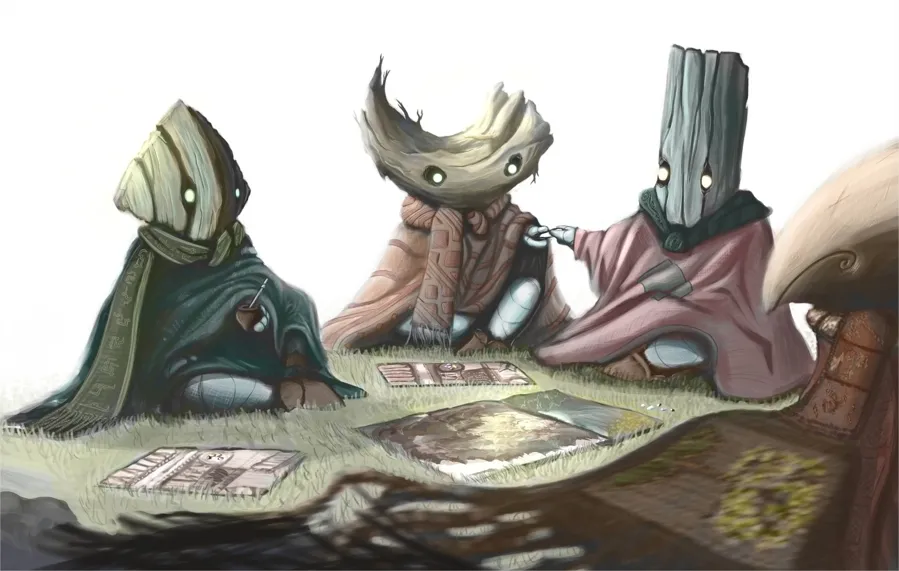
The Windfolk are who your PCs will be. They come in a variety of shapes and sizes (each has a clan and founding myth to help differentiate them) but at the heart of Windfolk society is the concept of Obligations. These are very closely related to the concept of mutual aid; they're reciprocal obligations that the Windfolk owe to each other as a networked people. They're also a critical part of the game, as obligations are frequently what will call Windfolk to travel and motivate them to adventures. It's also worth noting that this concept of obligation goes beyond just other Windfolk. Windfolk treat all sentient beings like this. Non Windfolk are judged on what they do, not on whether they look differently or have different cultural traditions. This is a very ecological theme and strongly differentiates Zephyr from games where other peoples are considered "monsters".
Even the Salt States (the nearest the setting has to a big bad) are that way by action and choice. Rather than obligations they have impersonal debt and they choose to deal with nature through violence and cruelty. Their "Heroes" are those who follow a path of "Heroic Violence", slaying and dominating those they come across in the name of their epic quests. (There is an obvious and interesting parallel with the role of "heroes" in other RPGs here).
Mechanically, each of your Windfolk is made up of Zephyr tokens. These not only represent your lifeforce, but also how you influence your environment. Together they're your Constitution. Having a good balance and number is important; if you find yourself without any particular colour you can no longer feel the emotions that colour helps to provide.
Actions are carried out through Reveals. These are done by a kind of bluffing game, where you and the Narrator secretly hold a number of tokens and you need to get a different number to them. This can be adjusted for difficulty. There are various tweaks to this base system (making things easier or more difficult, automatic success at a cost) that add some tactical depth.
Another use for Zephyr tokens is when they (in various ways) make their way to the regions. This allows you to make environmental changes, change the weather etc.
One of the most important aspects however is how they relate to Bonds. As you spend Zephyr tokens for success you get an emotional connection to an entity or concept. When you fulfill an obligation you can use them to weave Patterns, a special ability or relationship to the world your character has.
Zephyr's mechanics were, at least in my group's experience, somewhat difficult to pick up at first. This wasn't because they were badly written or designed; it was simply that you'll likely fine they feel unfamiliar at first. It's worth getting past that phase as they are very good once you get the grasp of them. If anything, it feels like I haven't done them justice in the writeup. There's an awful lot I haven't covered, although I obviously don't just want to rewrite the rulebook!
The visual art is worth mentioning. I am generally a notorious member of the "RPGs don't need art, it's an optional element" camp. This is different. The comic strips through are entirely integrated with the rest of the game, illustrating important mechanical concepts and highlighting how the game is played. I'll be honest. This doesn't mean it wasn't still an issue for me. This is a me issue; I'm just some one who has real problems processing important information if it has a large visual element. The more visual members of my group adored it and all found it really helped them pick up the mechanics. Currently, the game has an audiobook version that comes free with the PDF (incredibly impressive and much better than most large RPG companies manage). If feasible, I think it might be worth looking at a plain text version although I accept that people in my situation are rare!
So far, I've only really covered the core chapters of the book. I'm not going to go into the rest in detail, but they give a fantastic amount of support if you're wanting to run a campaign.
"What we found in the woods" is a creature compendium. "The Technologies" covers techniques, knowledge and equipment as well as having some really useful archetypes to aid in character creation. "The Tapestry" gives you patterns and much more lore on the Windfolk. "The Salt States" gives you an overview of that dark culture.
Worth singling out is "By the Bonfire". This has the expected storytelling tips but critically, also goes into the expectations of the game. It's expected you'll play over multiple sessions with a group of reasonably close friends. It isn't a game to try and run as a convention one shot. Laying this out up front is incredibly helpful and more games should do this.
I'll be honest. When I first saw that the game was 252 pages I was wary. But nothing here feels superfluous. You're not dealing with six page timelines with no likely relevance to play. Everything in the book feels both worthwhile and directly relevant to running a campaign.
Overall then?
"Not for everybody" is a cliche and one I overuse. But honestly, you can't get away from it here. Zephyr is odd. It's different. A lot of mainstream groups are likely to bounce off it.
"Unique" is even more overused to the point I rant about it. But here is one of the very rare occasions I am willing to give it the time of day. If you're wanting a truely unique RPG experience and willing to put the work in to get a handle on Zephyr, there is a high chance this will be the best purchase you've made all year.
Get Zephyr here.